The rules just changed. Is Australia paying attention?
First published 3 March.
Something shifted this weekend.
The US and Israel killed Iran's Supreme Leader in a targeted strike. France raided the Paris offices of X and summoned Elon Musk for questioning over allegations his platform was used to interfere in French politics and spread illegal content. The CEO of one of the world's most consequential AI companies told the Pentagon no and was punished for it. These aren't separate stories. They're a single picture of where power is moving, and how fast the old rules are being discarded.
Australia is at a turning point. We can choose to be swept along by more dominant world forces. Or we can choose the future we actually want. But that second option requires us to be paying attention — and I'm not sure we are.
On Iran - it's not simple
Many Iranians I know are relieved. Khamenei's regime was genuinely brutal to women, to dissidents, to anyone who questioned it. That relief is real and deserves acknowledgment.
And yet I feel unsettled.
State-sponsored assassination of foreign leaders isn't new. But it was covert, deniable, and when exposed in the 1970s it caused a major scandal. The Church Committee concluded assassination was "incompatible with American principles, international order, and morality." President Ford signed an executive order banning it. Successive presidents maintained that ban for fifty years.
Trump announced Khamenei's death on Truth Social like a sports result. That's the precedent that matters, not the act itself, but the open normalisation of it. Unchecked power doesn't back off. It finds new applications. History is consistent on this point.
Khamenei was killed in US-Israeli strikes on 28 February 2026. Prime Minister Albanese issued a statement of support within three hours, one of the first world leaders to do so , without parliamentary discussion. WSWS, 2 March 2026
On Anthropic — drawing a line
The Pentagon demanded that Anthropic lift all restrictions on its AI model Claude, a contract worth up to $200 million, including restrictions on autonomous weapons and mass domestic surveillance of American citizens. CEO Dario Amodei refused. "Threats do not change our position: we cannot in good conscience accede to their request," he said publicly.
Trump ordered all federal agencies to cease business with Anthropic. Defence Secretary Pete Hegseth then designated Anthropic a "supply chain risk to national security", a label, as Axios reported, usually reserved for companies from adversarial countries, such as Chinese tech giant Huawei.
Amodei drew two lines: no autonomous weapons and no mass surveillance. These aren't radical positions. They're the minimum conditions for technology to remain in service of human beings rather than replacing human judgment in decisions that should never be automated. That he had to draw them at all, and was punished for it, tells you exactly where power is currently heading.
History tends to vindicate those who draw these lines first.
We are not bystanders
Here is what I keep coming back to: Australia is not watching this from the outside. We are a primary asset within US strategic ambition. A senior Biden official reportedly admitted privately that AUKUS was about getting Australia "off the fence", adding "we have them locked in now for the next 40 years." The evidence for what that means in practice has been accumulating quietly, with remarkably little public debate.
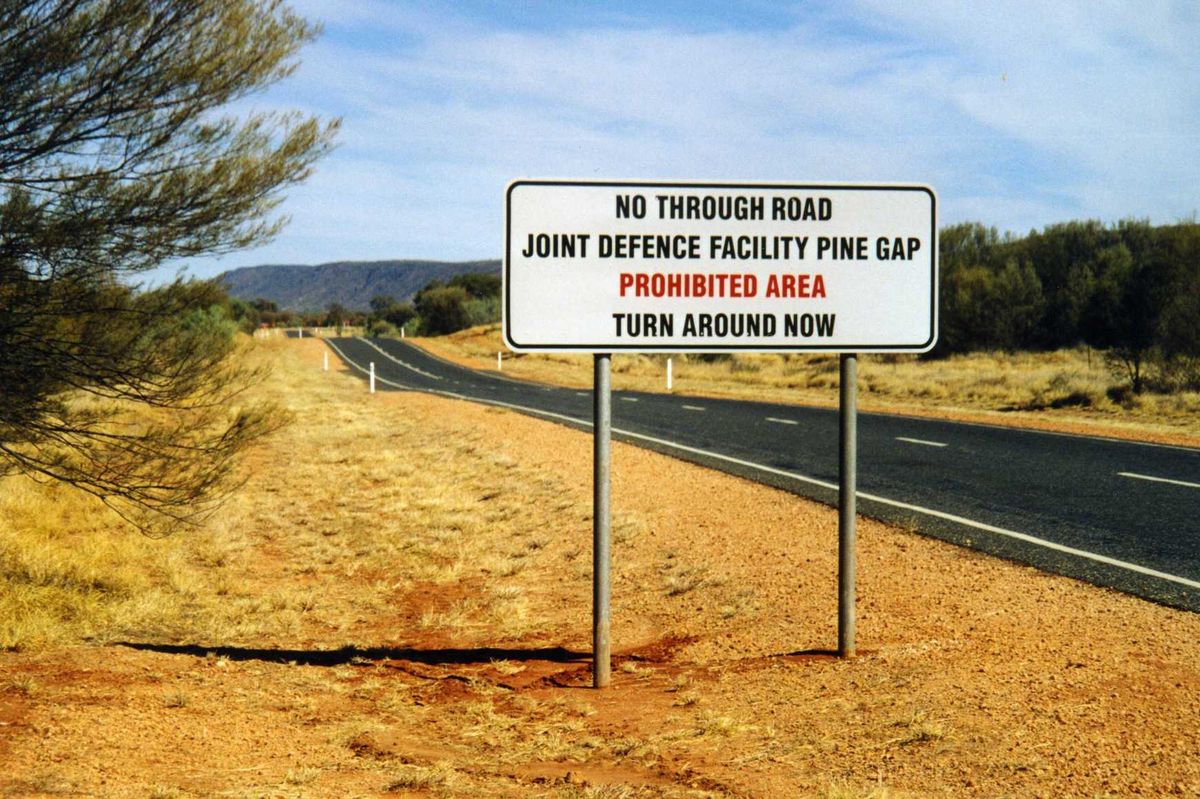
When a journalist asked Foreign Minister Penny Wong this week whether Pine Gap played any role in the strikes that killed Khamenei, she replied: "We never comment on that facility as a general proposition." That answer is itself an answer.
"Pine Gap literally hardwires us into the activities of the American military. We'll be culpable." ~ Prof. Richard Tanter, University of Melbourne
Professor Richard Tanter of the University of Melbourne has been saying this for years. A joint ABC/Intercept investigation documented that Pine Gap gathers intelligence used to pinpoint airstrikes. An NSA document from 2013 confirmed it plays a key role in providing geolocation data for military operations. Do we have a genuine veto over how it's used? I've tried to find a clear answer and I can't.
Palantir, which powers ICE deportations and battlefield AI in active conflict zones, has secured over $50 million in Australian government contracts since 2013, including a $7.15 million contract awarded without competitive tender. Our Future Fund holds over $103 million in Palantir shares, an investment whose human rights implications were never considered before it was made, according to Senate estimates testimony. We are simultaneously a customer, a funder, and an investor in a company whose technology is used in operations our government has not endorsed. When was that decision made? Was it made at all, or did it just accumulate?
The Trump administration has set a December 2026 deadline for Australia to hand over citizens' biometric data, facial images, fingerprints, DNA, five years of social media history, or risk losing visa-free US travel under the Enhanced Border Security Partnership. Our government has not confirmed negotiations are underway. It hasn't said no either. As Tess Rooney, lecturer in AI and data governance at the University of Canberra, has noted: biometric data cannot be replaced like a password. Once shared, it is permanently shared.
The US has also described Australia as its "indispensable partner" in critical minerals, a "periodic table that lights up like a Christmas tree." The $3 billion framework agreement signed in October 2025 is explicit: it exists to secure supply chains for US defence manufacturing. We are being positioned as a resource supplier for someone else's strategic future, a quarry, not a sovereign nation building its own industrial capability.
Meanwhile Blackstone, a single New York private equity firm managing over $1 trillion globally, now owns Hamilton Island, Crown Resorts, and AirTrunk, the largest data centre platform in the Asia-Pacific. Our data infrastructure, our tourism assets, our largest hospitality employer. Each deal looked like normal foreign investment. Together they tell a different story.
This is what friendly annexation looks like. Not flags. Not troops. Just the steady erosion of the conditions for genuine independence. Each piece looks defensible in isolation. It's only when you hold them together that something shifts.
The questions worth asking
What actually happens at Pine Gap, and do we have a genuine veto?
Why was the biometric data agreement not publicly announced or debated?
When did we decide our sovereign wealth fund should invest in a company powering ICE deportations?
Is the critical minerals deal building Australian industrial capability, or making us a quarry for someone else's future?
When the US does something we'd condemn if China did it, do we say so?
Do we have a genuine independent foreign policy, or one that only works in the space the alliance permits?
These are not anti-American questions. They are pro-Australian ones. And the fact that raising them feels slightly uncomfortable is itself worth sitting with.
Some of the most important resistance to what's happening right now is coming from Americans, Amodei being one of them. The alliance worth protecting isn't with American power as it's currently being exercised. It's with the Americans still defending the values we share, at real personal cost.
Australia is at a turning point. It's time to pay attention, and decide what kind of country we want to be, before someone else does it for us.
Hester Bax is based in Australia. Opinions are entirely her own, not those of her employer.
Sources: Penny Wong press conference, 1 March 2026 · Axios, Anthropic/Pentagon, 27 Feb 2026 · CNN, 27 Feb 2026 · Anthropic statement · The Intercept / ABC, Pine Gap · Honi Soit, Future Fund/Palantir · SBS News, biometric data · France 24, Musk/France