How Australia entered an unlawful war
Anthony Albanese has built his political identity on accountability. On the idea that government should answer to the people it represents rather than to the powerful interests surrounding it. He came to power promising transparency and a different kind of leadership. He established the War Powers Inquiry his party promised in opposition. When that inquiry found that parliamentary oversight of military decisions had become, in its own words, "less clear and less substantial in recent decades," his government rejected every substantive recommendation. Defence Minister Marles reaffirmed what he called the "captain's call" system: the Prime Minister decides, and parliament is informed afterward, if at all.
As ASPI senior fellow Graeme Dobell wrote in 2022, parliament has been "the ghost with no formal voice in the most fundamental choice a nation can make" since federation. That was the problem Labor's inquiry was asked to solve. This piece sets out what they did with it instead — and what you can do about it.
Australia's unqualified support for unlawful strikes on Iran
On 27 February 2026, Oman's foreign minister announced that Iran had agreed to never stockpile enriched uranium and to submit to full IAEA verification. A negotiated settlement appeared, finally, within reach. The following day, the United States and Israel launched nearly 900 strikes on Iranian targets in 12 hours. Khamenei was killed. Iran retaliated. The war began.
The strikes had been planned for months — confirmed by the US Joint Chiefs of Staff. The military timetable was set before diplomacy was given a chance to succeed. What makes this particularly striking is that the US Director of National Intelligence had testified in March 2025 that Iran was not pursuing nuclear weapons, a finding the head of the IAEA affirmed. Albanese justified Australia's support for the strikes as "acting to prevent Iran from obtaining a nuclear weapon" — a rationale directly contradicted by his own intelligence community's assessment, made public a year earlier.
Legal experts from multiple jurisdictions found the strikes lacked any valid justification under international law. The UN special rapporteur on counterterrorism said plainly: "This is not lawful self-defence against an armed attack by Iran, and the UN Security Council has not authorised it." The Conversation's legal analysts found the strikes violated international law. Norway said the same. France condemned them. Every time an Australian journalist asked the Prime Minister, the Defence Minister or the Foreign Minister whether the strikes were legal, the question was deferred to the United States.
Australia was not told the strikes were coming. It was presented with a war already started, asked to stand beside its ally, and did so within 24 hours — without conditions, without a legal assessment, and without a parliamentary debate. The pattern of that response — immediate, unqualified support, no expression of surprise — is more consistent with foreknowledge than with a government genuinely caught off guard. The government has neither confirmed nor denied prior knowledge. It has simply moved on.
The Australians aboard
On 4 March, a United States submarine fired a torpedo at the Iranian frigate IRIS Dena in international waters off Sri Lanka. The ship sank within minutes. Eighty-seven sailors died. Three of those aboard the submarine were Australian, embedded as part of the AUKUS training rotation — one of between 50 and 100 Australian naval personnel deployed across America's submarine fleet ahead of Australia's acquisition of its own.
This is what AUKUS means in practice. Not future submarines, not abstract strategic capability — Australian sailors, embedded in US vessels, present when those vessels conduct operations Australia has not authorised, in a war Australia was not consulted on before it began.
Neil James, executive director of the Australian Defence Association, acknowledged it is "reasonably rare" for Australians embedded with another nation's military to go to war against a country Australia itself was not at war with. That is a significant understatement. In the history of Australian defence, it is without precedent.
Albanese confirmed their presence on 6 March: "I can confirm that there were three Australian personnel on board that vessel. I can confirm also, though, that no Australian personnel have participated in any offensive action against Iran." The government offered a mechanism — that frameworks exist for Australians to recuse themselves during engagements — but declined to explain how that recusal operated in practice, or whether it did. The assertion has not been tested in parliament. Parliament has not been convened.
A secret new defence committee
By convention, the Prime Minister has 30 days from a deployment to make a statement to parliament. On day four of this one, Albanese passed a bill that determined what that scrutiny would look like when it arrived.
On 3 March, one day before the IRIS Dena was sunk, Senator David Shoebridge rose in the Senate to ask the Labor minister a direct question about the new defence committee then being debated. "Is it intended that this new secret committee would be consulted before Australia supported an illegal war by the United States and Israel on Iran?" he asked. The minister declined to answer directly.
The following day, Labor and the Liberals passed the Defence Amendment Bill. The Albanese government described it as implementing a recommendation of the War Powers Inquiry. What it did not say is that the committee excludes the Greens and crossbenchers, that the Prime Minister controls membership in consultation with the Opposition Leader, and that its hearings are held entirely in secret. A Labor senator said openly in the chamber that the most powerful thing about the committee was that it would all happen in secret and nobody would see. It is on Hansard.
The government's defence is that the committee is modelled on the Parliamentary Joint Committee on Intelligence and Security. That is a fair point as far as it goes. What it does not address is the timing: this committee was constituted and passed on the day Australians were aboard a submarine that killed 87 people, in a war the committee was explicitly not designed to prevent.
The inquiry the government cited as justification had recommended broader oversight. The legislation delivered narrower oversight, controlled by the executive, invisible to the public, and without the voices most likely to ask the questions that inconvenience those in power.
What was decided, and in which room
The same government that insists on international law when it suits the alliance has nothing to say when the alliance is the one doing the violating. Australia joined more than 20 countries at the International Court of Justice asserting Russia's invasion of Ukraine had no legal basis. It has pointed to the illegality of Russia's conduct repeatedly and publicly. On Iran, it has said the legality is a matter for others.
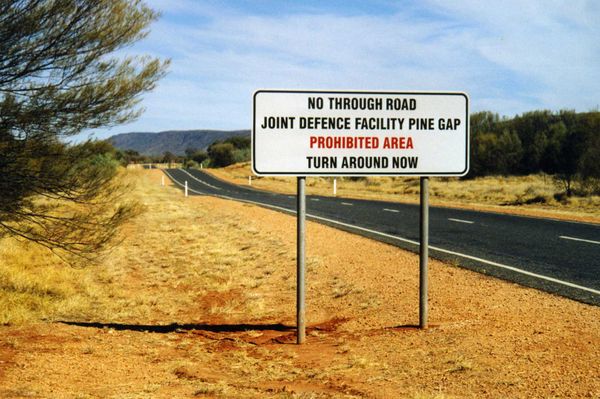
Australia did not vote on this war. No parliamentary motion was put. No ministerial statement was made to the House. The National Security Committee of Cabinet met and decisions were made. Those decisions committed Australian personnel to a vessel that sank an Iranian ship in international waters, killing 87 sailors. They committed Australian intelligence infrastructure, including Pine Gap, to a conflict the government simultaneously declines to assess for legality.
On 10 March, Albanese announced the deployment of 85 further personnel, a Wedgetail surveillance aircraft and AMRAAM missiles to the UAE — framed as defensive, yet capable of mapping launch locations and integrating targeting data into a broader military operation whose legal basis Australia refuses to examine.
The committee that will oversee these decisions meets in secret. The 30-day clock is running. What Albanese builds while it ticks will tell us more than any statement he eventually makes.
What is actually at stake
It is worth being precise.
Australian personnel are in an active conflict zone under the command of a foreign military, in a war the Australian government has not put to parliament. More will follow: the Wedgetail deployment, the missile systems, the ongoing rotations under AUKUS. As the alliance deepens — and AUKUS is explicitly designed to deepen it — the question of when Australian personnel might be killed, in a conflict Australia did not authorise, is not hypothetical. It is a matter of when, not if, unless the trajectory changes.
The legal framework for this war is contested at the highest levels of international law. Multiple allied governments have distanced themselves. The rationale offered by Albanese — preventing Iran from acquiring nuclear weapons — was contradicted by his own intelligence community a year before the war began. No legal advice has been tabled. No parliamentary debate has been held. The committee that might ask these questions meets behind closed doors, without the senators most likely to press them.
This is not a partisan question. It is a question about whether Australians have any meaningful say in when their country goes to war, and whether young Australians can be placed in harm's way on the authority of a cabinet committee that reports to no one.
What you can do
Write to your MP directly — a letter, not a form — asking them to make a parliamentary statement on the legal basis for Australia's involvement. Ask them whether Australia had prior knowledge of the strikes. Ask them whether Pine Gap intelligence was used. These are procedural questions and they are legitimate regardless of political affiliation.
Contact the crossbench. David Pocock, David Shoebridge, the teal independents. They are locked out of the secret committee. They are asking the right questions and they need to know constituents are watching.
Support Declassified Australia, the Australia Institute, the Human Rights Law Centre and Australians for War Powers Reform. These organisations are doing the accountability work that government has stopped doing.
Australia has been here before — Vietnam, Iraq, Afghanistan — and in each case the full cost of the decision became clear long after it was made, in rooms the public never saw. The difference now is that the architecture for scrutiny is being closed faster than ever before, and the conflict is escalating in real time.
The war was decided without us. The committee overseeing it meets without us. But the parliament that should be debating it is still sitting, and the people elected to ask the hard questions are still there — if enough of us tell them we are paying attention.
Sources: Al Jazeera — US-Israeli strikes legal analysis · The Conversation — International law and Australia's choice on Iran · The Conversation — US-Israeli strikes have blown up international law · Law Society Journal — Neither preemptive nor legal · Defense News — Australian submariners and the Iran war · PM.gov.au — Albanese Sky News interview 6 March · OpenAustralia Hansard — Defence committee debate 3 Mar · OpenAustralia Hansard — Defence committee passed 4 Mar · GlobalSecurity — Parliament passes defence committee legislation · Mirage News — Secret AUKUS committee · Wikipedia — Sinking of IRIS Dena · Canberra Times — New defence committee · ASPI Strategist — War powers conventions · ASPI Strategist — Parliament ponders war powers · Green Left — War powers inquiry · Australians for War Powers Reform · Al Jazeera — Australia deploys to UAE
Opinions entirely my own, not those of my employer.